Skip to content
  • Categories
  • Recent
  • Popular
  • Support
  • MyRoute-app
Collapse
Brand Logo

MRA Community Forum

  1. Home
  2. The MyRoute-app
  3. [App] Suggestions and Discussion
  4. Shaping points and Via points

Shaping points and Via points

Scheduled Pinned Locked Moved [App] Suggestions and Discussion
30 Posts 9 Posters 1.2k Views 4 Watching
  • Oldest to Newest
  • Newest to Oldest
  • Most Votes
Reply
  • Reply as topic
Log in to reply
This topic has been deleted. Only users with topic management privileges can see it.
  • Herman Veldhuizenundefined Herman Veldhuizen

    @BertM You can get the ETA info for viapoints (hand icon) or for both viapoints and shaping points (droplet icon). How you navigate a route (route or route as track) makes currently no difference.
    If you use shaping points for your possible stops they will eventually be skipped (still annoying to be sent back to the ones you missed and you will unfortunately also see the ETA for points which you added for the sole purpose to shape the route).
    If you use via points for your possible stops then you can filter out the shaping points but the via points will never be skipped.
    A number of people (and me) in this forum would like to see that the route can get priority over the points. They dont necessarily want to stop at each possible stop and expect the app to skip each point which is behind them on the route.
    Most apps I know work that way. Apparently there is something missing in the HERE platform today to make this an option.

    Con Hennekensundefined Offline
    Con Hennekensundefined Offline
    Con Hennekens
    Alpha tester
    wrote last edited by
    #16

    @Herman-Veldhuizen said in Shaping points and Via points:

    A number of people (and me) in this forum would like to see that the route can get priority over the points. They dont necessarily want to stop at each possible stop and expect the app to skip each point which is behind them on the route.
    Most apps I know work that way. Apparently there is something missing in the HERE platform today to make this an option.

    That's correct, there is no way of knowing what point is "behind" you in a route, only the first targeted route point is relevant in the calculations. I am not sure how other apps work, but I do know that Garmins, when navigating a track, do "sense" if they are actually on the track and go from there (which also is not always the most desirable method).

    What I would like to know is, considering your long standing (constructive!) critique and your claim that most apps work better in this regard, what it is that keeps you on MRA. It must have very strong advantages otherways 😉

    I am just an enthusiastic MRA user, and hope you will be one too!

    Most motorcycle problems are caused by the nut that connects the handlebar to the saddle.

    Streetpilot 2610 / Zumo 660 / Zumo 395 / Motorola Thinkphone + MRA app

    Herman Veldhuizenundefined 1 Reply Last reply
    0
    • Herman Veldhuizenundefined Herman Veldhuizen

      @Martin-Wilcke Unfortunately this is not what I observe. I wish it did and i believe it worked like that for a short while when route as track was added.
      ETA info to my (optional) waypoints are important for me. So I have never considered pure track navigation.
      When I navigate my route as track the app DOES use the way points in my route to navigate. I suppose it tries to find a logical reentry point but it also sends me back to a waypoint. How many times it tries to send me back to a shaping point seems to depend on how far the next point is.

      Martin Wilckeundefined Offline
      Martin Wilckeundefined Offline
      Martin Wilcke
      wrote last edited by Martin Wilcke
      #17

      @Herman-Veldhuizen said in Shaping points and Via points:

      Unfortunately this is not what I observe.

      My thoughts were meant as a suggestion for a change:

      When navigating "Routes as tracks", all waypoints (SPs and VIAs) should be skipped automatically, as this is how track navigation works.

      From a conceptual POV, it is "line priority over point priority".

      1 Reply Last reply
      1
      • Con Hennekensundefined Con Hennekens

        @Herman-Veldhuizen said in Shaping points and Via points:

        A number of people (and me) in this forum would like to see that the route can get priority over the points. They dont necessarily want to stop at each possible stop and expect the app to skip each point which is behind them on the route.
        Most apps I know work that way. Apparently there is something missing in the HERE platform today to make this an option.

        That's correct, there is no way of knowing what point is "behind" you in a route, only the first targeted route point is relevant in the calculations. I am not sure how other apps work, but I do know that Garmins, when navigating a track, do "sense" if they are actually on the track and go from there (which also is not always the most desirable method).

        What I would like to know is, considering your long standing (constructive!) critique and your claim that most apps work better in this regard, what it is that keeps you on MRA. It must have very strong advantages otherways 😉

        Herman Veldhuizenundefined Offline
        Herman Veldhuizenundefined Offline
        Herman Veldhuizen
        wrote last edited by Herman Veldhuizen
        #18

        @Con-Hennekens Yes MRA has many good things. But thats maybe something for another topic. I might come over as somebody who complains a lot but I am impressed by how much work has been done and how the app develops. Kudos to the team!

        One thing I want to mention is that MRA today is not only for bikers and I hope it stays like that. It's up to the team of coarse but I see big potential for other users like me. MRA could for example have the concept of a pluggable route library and offer it with a separate license. Companies could have their own internal library that way.

        The issue that the route cannot be given the priority over the points is one which keeps popping up in this forum. I hope (and are convinced) that it will be possible one day. I dont have many issues with MRA but this one tops the list by far.

        Con Hennekensundefined 1 Reply Last reply
        0
        • Herman Veldhuizenundefined Herman Veldhuizen

          @Con-Hennekens Yes MRA has many good things. But thats maybe something for another topic. I might come over as somebody who complains a lot but I am impressed by how much work has been done and how the app develops. Kudos to the team!

          One thing I want to mention is that MRA today is not only for bikers and I hope it stays like that. It's up to the team of coarse but I see big potential for other users like me. MRA could for example have the concept of a pluggable route library and offer it with a separate license. Companies could have their own internal library that way.

          The issue that the route cannot be given the priority over the points is one which keeps popping up in this forum. I hope (and are convinced) that it will be possible one day. I dont have many issues with MRA but this one tops the list by far.

          Con Hennekensundefined Offline
          Con Hennekensundefined Offline
          Con Hennekens
          Alpha tester
          wrote last edited by
          #19

          @Herman-Veldhuizen, by no means I meant to imply you being a complainer, hence the addition of the word "constructive!" as in "opbouwende kritiek" in Dutch. I think your way of usage is interesting for sure but probably not practised a lot, not by the target audience anyway. It could be a future expansion perhaps, but in that case indeed probably as an extra licence (more as a logistics solution). I don't think however that is something MRA is willing to spent time on at the moment. For sure not until the new web planner is live and bug free.

          @Martin-Wilcke said in Shaping points and Via points:

          When navigating "Routes as tracks", all waypoints (SPs and VIAs) should be skipped automatically, as this is how track navigation works.

          That is a bit strange, since the one-and-only function of a VIA point is that it cannot be skipped automatically 😉 . How track navigation works is without any route points at all.
          I am just an enthusiastic MRA user, and hope you will be one too!

          Most motorcycle problems are caused by the nut that connects the handlebar to the saddle.

          Streetpilot 2610 / Zumo 660 / Zumo 395 / Motorola Thinkphone + MRA app

          Herman Veldhuizenundefined Martin Wilckeundefined 2 Replies Last reply
          0
          • Con Hennekensundefined Con Hennekens

            @Herman-Veldhuizen, by no means I meant to imply you being a complainer, hence the addition of the word "constructive!" as in "opbouwende kritiek" in Dutch. I think your way of usage is interesting for sure but probably not practised a lot, not by the target audience anyway. It could be a future expansion perhaps, but in that case indeed probably as an extra licence (more as a logistics solution). I don't think however that is something MRA is willing to spent time on at the moment. For sure not until the new web planner is live and bug free.

            @Martin-Wilcke said in Shaping points and Via points:

            When navigating "Routes as tracks", all waypoints (SPs and VIAs) should be skipped automatically, as this is how track navigation works.

            That is a bit strange, since the one-and-only function of a VIA point is that it cannot be skipped automatically 😉 . How track navigation works is without any route points at all.

            Herman Veldhuizenundefined Offline
            Herman Veldhuizenundefined Offline
            Herman Veldhuizen
            wrote last edited by
            #20

            @Con-Hennekens In this topic (https://forum.myrouteapp.com/topic/9552/waypoint-skipping.-mra-vs-beeline) I made a test route in both MRA and Beeline. Both have bikers as their target audience. The behaviour of the apps are however very different when it comes to skipping points. I dont think that Beelines behaviour is odd.

            1 Reply Last reply
            1
            • Bouke Entundefined Offline
              Bouke Entundefined Offline
              Bouke Ent
              wrote last edited by Bouke Ent
              #21

              i also looked at beeline. beeline is better is follow the plan you made. MRA is better to plan. MRA Next has many good point but also to many functions and some main function like how to deal with track and gpx file or skipping shaping point or follow the route when back on the route you planned are in my opinion not perfect. I hope in planning of future development.

              1 Reply Last reply
              0
              • Con Hennekensundefined Con Hennekens

                @Herman-Veldhuizen, by no means I meant to imply you being a complainer, hence the addition of the word "constructive!" as in "opbouwende kritiek" in Dutch. I think your way of usage is interesting for sure but probably not practised a lot, not by the target audience anyway. It could be a future expansion perhaps, but in that case indeed probably as an extra licence (more as a logistics solution). I don't think however that is something MRA is willing to spent time on at the moment. For sure not until the new web planner is live and bug free.

                @Martin-Wilcke said in Shaping points and Via points:

                When navigating "Routes as tracks", all waypoints (SPs and VIAs) should be skipped automatically, as this is how track navigation works.

                That is a bit strange, since the one-and-only function of a VIA point is that it cannot be skipped automatically 😉 . How track navigation works is without any route points at all.

                Martin Wilckeundefined Offline
                Martin Wilckeundefined Offline
                Martin Wilcke
                wrote last edited by Martin Wilcke
                #22

                @Con-Hennekens said in Shaping points and Via points:

                since the one-and-only function of a VIA point is that it cannot be skipped automatically

                Hence, my suggestion for a change.

                When navigating a track, there are two common concepts to lead you back in case of a deviation:

                • to the point where you left the track

                • to the most logical point in the forward direction

                There might be additional "points" (waypoints, POIs, whatever) along the track; however, they are informational only (may be announced) and do not influence the navigation.

                This concept is becoming increasingly popular, and it would be a good idea to implement it in MRA as well.

                BertMundefined 1 Reply Last reply
                2
                • Martin Wilckeundefined Martin Wilcke

                  @Con-Hennekens said in Shaping points and Via points:

                  since the one-and-only function of a VIA point is that it cannot be skipped automatically

                  Hence, my suggestion for a change.

                  When navigating a track, there are two common concepts to lead you back in case of a deviation:

                  • to the point where you left the track

                  • to the most logical point in the forward direction

                  There might be additional "points" (waypoints, POIs, whatever) along the track; however, they are informational only (may be announced) and do not influence the navigation.

                  This concept is becoming increasingly popular, and it would be a good idea to implement it in MRA as well.

                  BertMundefined Offline
                  BertMundefined Offline
                  BertM
                  wrote last edited by
                  #23

                  @Martin-Wilcke said in Shaping points and Via points:

                  • to the most logical point in the forward direction

                  This seems like an interesting point to me:
                  When following a track, you follow a line.

                  How does the program know what the next point is, i.e., the direction you want to go?
                  I believe a program can only calculate the nearest point, and unfortunately, that can also be in the wrong direction.

                  Martin Wilckeundefined 1 Reply Last reply
                  0
                  • BertMundefined BertM

                    @Martin-Wilcke said in Shaping points and Via points:

                    • to the most logical point in the forward direction

                    This seems like an interesting point to me:
                    When following a track, you follow a line.

                    How does the program know what the next point is, i.e., the direction you want to go?
                    I believe a program can only calculate the nearest point, and unfortunately, that can also be in the wrong direction.

                    Martin Wilckeundefined Offline
                    Martin Wilckeundefined Offline
                    Martin Wilcke
                    wrote last edited by
                    #24

                    @BertM said in Shaping points and Via points:

                    How does the program know what the next point is, i.e., the direction you want to go?

                    Trackpoints <trkpt> do have a specific order, and therefore a track <trk> has a direction. "Forward direction" means "Track forward direction".

                    BertMundefined 1 Reply Last reply
                    0
                    • Martin Wilckeundefined Martin Wilcke

                      @BertM said in Shaping points and Via points:

                      How does the program know what the next point is, i.e., the direction you want to go?

                      Trackpoints <trkpt> do have a specific order, and therefore a track <trk> has a direction. "Forward direction" means "Track forward direction".

                      BertMundefined Offline
                      BertMundefined Offline
                      BertM
                      wrote last edited by
                      #25

                      @Martin-Wilcke said in Shaping points and Via points:

                      @BertM said in Shaping points and Via points:

                      How does the program know what the next point is, i.e., the direction you want to go?

                      Trackpoints <trkpt> do have a specific order, and therefore a track <trk> has a direction. "Forward direction" means "Track forward direction".

                      But you are not ON the track... your outside the track.
                      Lets assume you left the track on point 3, and now you near point 6, how does the app knows your best point to enter is 7 instead of 6?

                      Martin Wilckeundefined 1 Reply Last reply
                      0
                      • BertMundefined BertM

                        @Martin-Wilcke said in Shaping points and Via points:

                        @BertM said in Shaping points and Via points:

                        How does the program know what the next point is, i.e., the direction you want to go?

                        Trackpoints <trkpt> do have a specific order, and therefore a track <trk> has a direction. "Forward direction" means "Track forward direction".

                        But you are not ON the track... your outside the track.
                        Lets assume you left the track on point 3, and now you near point 6, how does the app knows your best point to enter is 7 instead of 6?

                        Martin Wilckeundefined Offline
                        Martin Wilckeundefined Offline
                        Martin Wilcke
                        wrote last edited by
                        #26

                        @BertM

                        From what I've experienced, the route back to the track is calculated as if you were planning a route—and in fact, some programs do exactly this: the track remains unchanged, and an additional route is generated.

                        Of course, I don't know the exact program logic, but I imagine it works like this:

                        • First, various entry points are determined (i.e., points where a routable path intersects the track), possibly as an initial approximation based on the straight-line distance.

                        • Then the resulting routes are calculated based on an explicit or implicitly assumed routing profile (fast, short, winding, etc.).

                        • The result that best matches the profile specifications is then used to generate the route back to the track

                        1 Reply Last reply
                        1
                        • Martin Wilckeundefined Offline
                          Martin Wilckeundefined Offline
                          Martin Wilcke
                          wrote last edited by Martin Wilcke
                          #27

                          @BertM
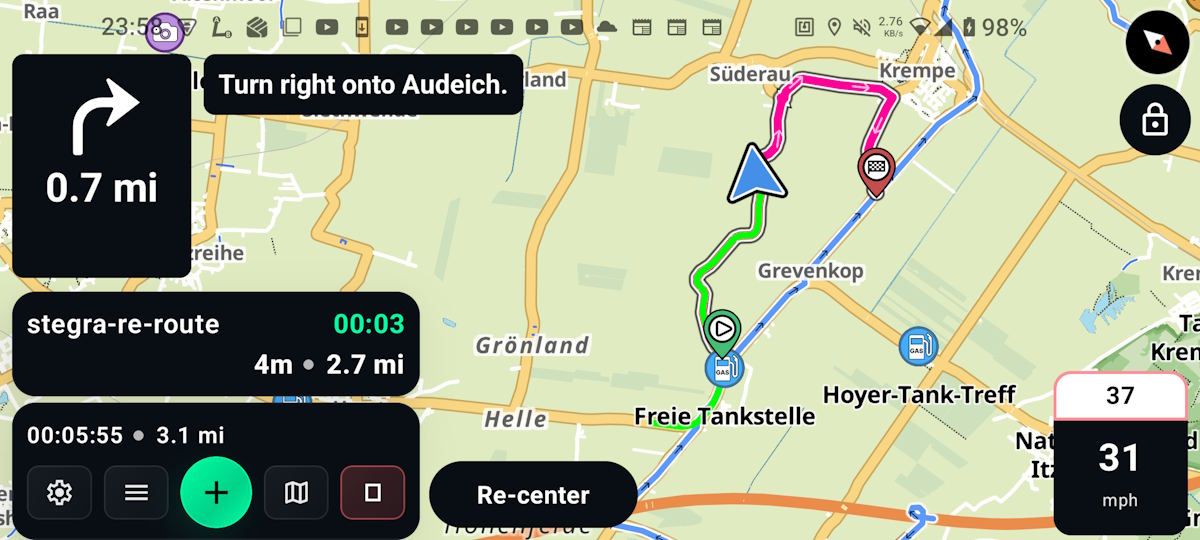
                          Here's a screenshot (actually a simulation with Stegra.io ) :

                          • the blue line is the original track

                          • the red/purple is the calculated (re-) route

                          • the green is the recorded track

                          track.jpg

                          1 Reply Last reply
                          0
                          • BertMundefined Offline
                            BertMundefined Offline
                            BertM
                            wrote last edited by
                            #28

                            I understand your point and

                            • to the most logical point in the forward direction

                            is the key:
                            You are going in the direction of the original track, so the heading is importent for calculation.
                            If you made a u-turn it will send you back to the point where you came from.

                            Martin Wilckeundefined 1 Reply Last reply
                            0
                            • BertMundefined BertM

                              I understand your point and

                              • to the most logical point in the forward direction

                              is the key:
                              You are going in the direction of the original track, so the heading is importent for calculation.
                              If you made a u-turn it will send you back to the point where you came from.

                              Martin Wilckeundefined Offline
                              Martin Wilckeundefined Offline
                              Martin Wilcke
                              wrote last edited by
                              #29

                              @BertM said in Shaping points and Via points:

                              If you made a u-turn it will send you back to the point where you came from.

                              In the example above with Stegra.io?

                              No. As I'm currently navigating an A-B route, a U-turn or deviation from the route will force a recalculation, and the algorithm will always lead me to the route endpoint, the intersection with the track.

                              As soon as I reach this point, route navigation mode will stop, and track navigation mode will automatically take over, providing TBT instructions based on the track.

                              DMD works the same way.

                              1 Reply Last reply
                              0
                              • Paul Smith 3undefined Offline
                                Paul Smith 3undefined Offline
                                Paul Smith 3
                                wrote last edited by
                                #30

                                How about a compromise? Ask the developers to add an option in settings to specify on a given route how close to waypoint is close enough to move on. The figure is already hard-coded in the navigation software at somewhere around 25 meters, but I suggest making it dynamic. Even 25 meters can be too much in a medieval city center and 500 meters is more than enough on rural back roads.

                                1 Reply Last reply
                                0
                                Reply
                                • Reply as topic
                                Log in to reply
                                • Oldest to Newest
                                • Newest to Oldest
                                • Most Votes


                                • 1
                                • 2
                                ACTIVE USERS
                                Nick Carthewundefined
                                Nick Carthew
                                Paul Smith 3undefined
                                Paul Smith 3
                                Jörgenundefined
                                Jörgen
                                Martin Wilckeundefined
                                Martin Wilcke
                                BertMundefined
                                BertM
                                Herman Veldhuizenundefined
                                Herman Veldhuizen
                                Bouke Entundefined
                                Bouke Ent
                                Con Hennekensundefined
                                Con Hennekens
                                Marinus van Deudekomundefined
                                Marinus van Deudekom
                                POPULAR TOPICS
                                • Next+ 1st impressions
                                  Steve Jarrellundefined
                                  Steve Jarrell
                                  1
                                  8
                                  437

                                • Riding mode in routeplanner
                                  Nick Carthewundefined
                                  Nick Carthew
                                  0
                                  2
                                  55

                                • Kruisje soms wit soms zwart
                                  Hns_Brwrundefined
                                  Hns_Brwr
                                  0
                                  4
                                  144

                                • Shaping points and Via points
                                  Paul Smith 3undefined
                                  Paul Smith 3
                                  0
                                  30
                                  1.2k

                                • Audible speed camera alerts without active route in CarPlay
                                  Rob Verhoeffundefined
                                  Rob Verhoeff
                                  1
                                  6
                                  178

                                • Add option for output audio as HFP instead of A2DP
                                  ConiKostundefined
                                  ConiKost
                                  1
                                  3
                                  38
                                MY GROUPS
                                • Login

                                • Login or register to search.
                                • First post
                                  Last post
                                0
                                • Categories
                                • Recent
                                • Popular
                                • Support
                                • MyRoute-app